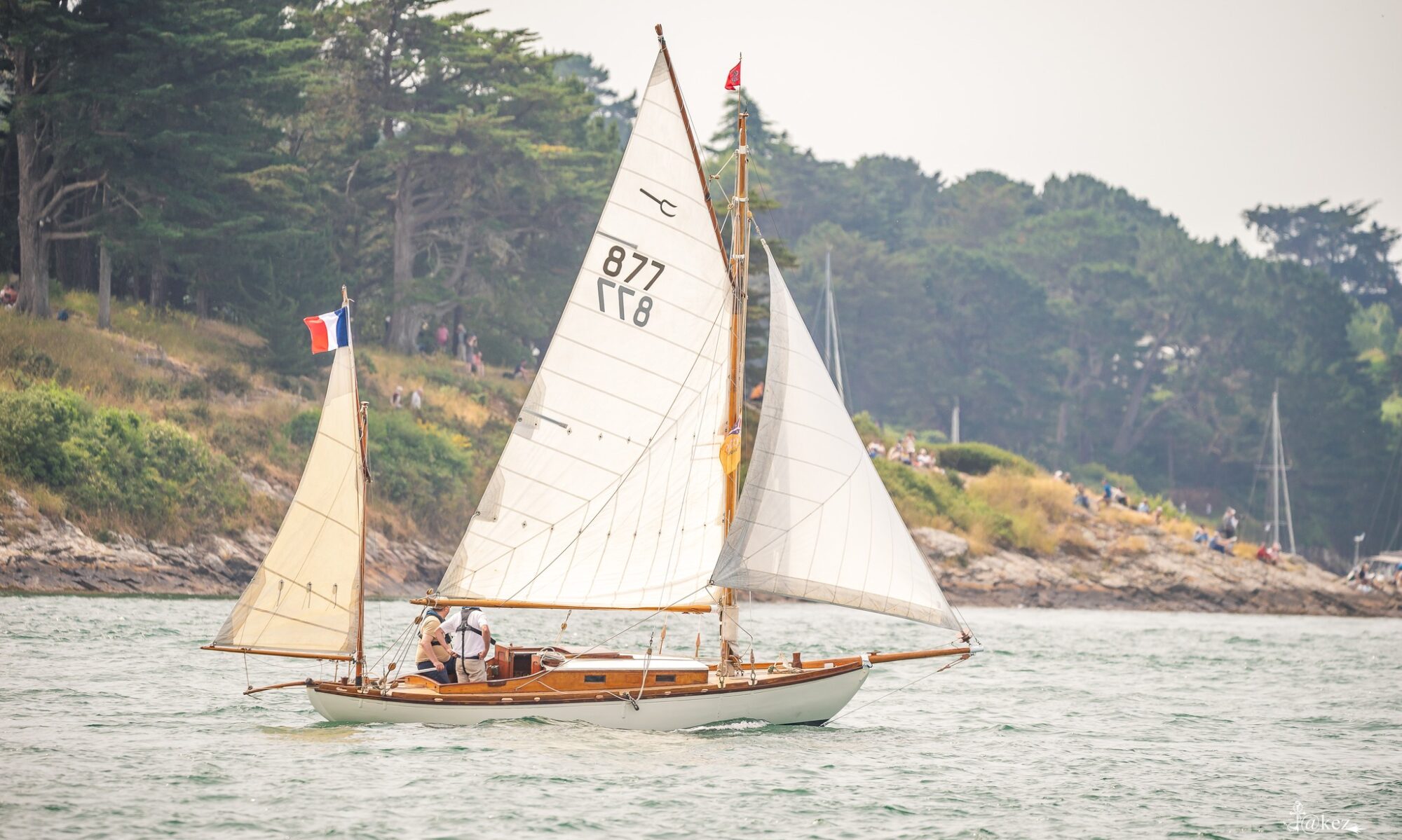
Forbears
Sheila’s forbears are remembered on her cabin table, by marquetarian Ernest Yves.
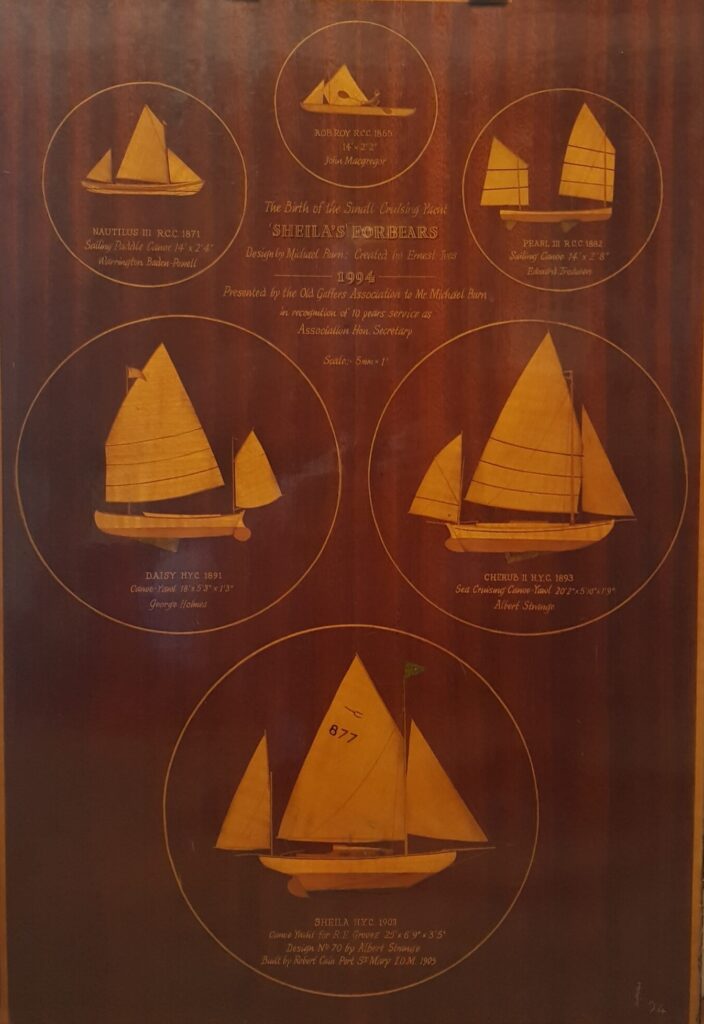
5 boats and 5 sailors and architects are presented. Together, they “invented” coastal cruising, and Sheila was a significant part in this invention.
Rob Roy
John MacGregor’s (1825–1892) influence on sailing and pleasure boating (including in France) is fundamental.
He essentially invented the concept of solo coastal cruising at a time when “yachting” was either a matter of fierce competition or a luxury reserved for massive vessels with professional crews. His trip from London to the French canal network and then down the Danube and back, with his canoe, included sailing, paddling, and quite a number of miles using the train and ferry networks. His book “A Thousand Miles in the Rob Roy Canoe” is a key influence for Robert Louis Stevenson who made a similar trip, and later such luminaries as Joshua Slocum and Jack London.
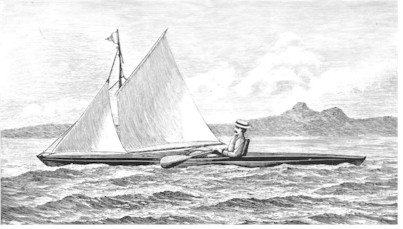
Regarding his specific impact on the French sailing world, the turning point is 1867 with the Yawl “Rob Roy” in Paris. This is the key moment of MacGregor’s influence in France and it did not occur on its canals, but on the Seine during the 1867 Universal Exposition in Paris.
MacGregor did not arrive by train, he arrived by sea. He crossed the English Channel from London, reached Le Havre, and then sailed up the Seine to the Pont de l’Alma aboard his 21-foot (6.40-meter) yawl, also named the Rob Roy.
- It was a visual shock – at the time, seeing a man arrive from abroad alone on such a small sailboat was a revolution. He proved to the French public that a boat did not need to be immense to be a sea-going vessel. It was also a technical demonstration: his boat was put on display during the Exposition. Its plans were scrutinized by engineers and the first generation of French sailing enthusiasts. This was effectively the birth of cruising yachting in France.
- It was a technical innovation : the “Pocket Cruiser” – MacGregor introduced technical solutions that inspired French naval architects of the late 19th century to design more manageable boats:
– Shallow Draft: His boat was designed to be “beached” and to enter the small fishing ports of Normandy and Brittany. He paved the way for coastal exploration in France, where large yachts were forced to remain offshore.
– Yawl Rig: MacGregor preferred the yawl rig (two masts, with the smaller mizzen mast located aft of the rudder) because it allowed the sail area to be easily divided. In a gale, one could drop the mainsail and remain under mizzen and jib. This safety feature appealed to French sailors who feared the rough conditions of the English Channel.
– Interior Layout: He proved that one could sleep, cook, and live aboard a 6-meter unit, laying the groundwork for the ergonomics found in modern cruising sailboats. - It is the philosophical revolution of the Solo Adventure
Before MacGregor, pleasure sailing in France (which was very active in places like Argenteuil or Le Havre) followed two main paths:
– Social: Sailing to display one’s wealth.
– Sporting: Sailing for pure racing.
MacGregor introduced a third path: spiritual autonomy. In his book The Voyage Alone in the Yawl Rob Roy, he explained that the sea is a space for individual freedom.
This philosophy deeply marked pioneers of French sailing like Alain Gerbault and later Bernard Moitessier, two Robert Stevenson and Jack London readers, who inherited this vision of a lone sailor facing the elements as the master of his own destiny.
- It spread via the “Yacht Club de France”
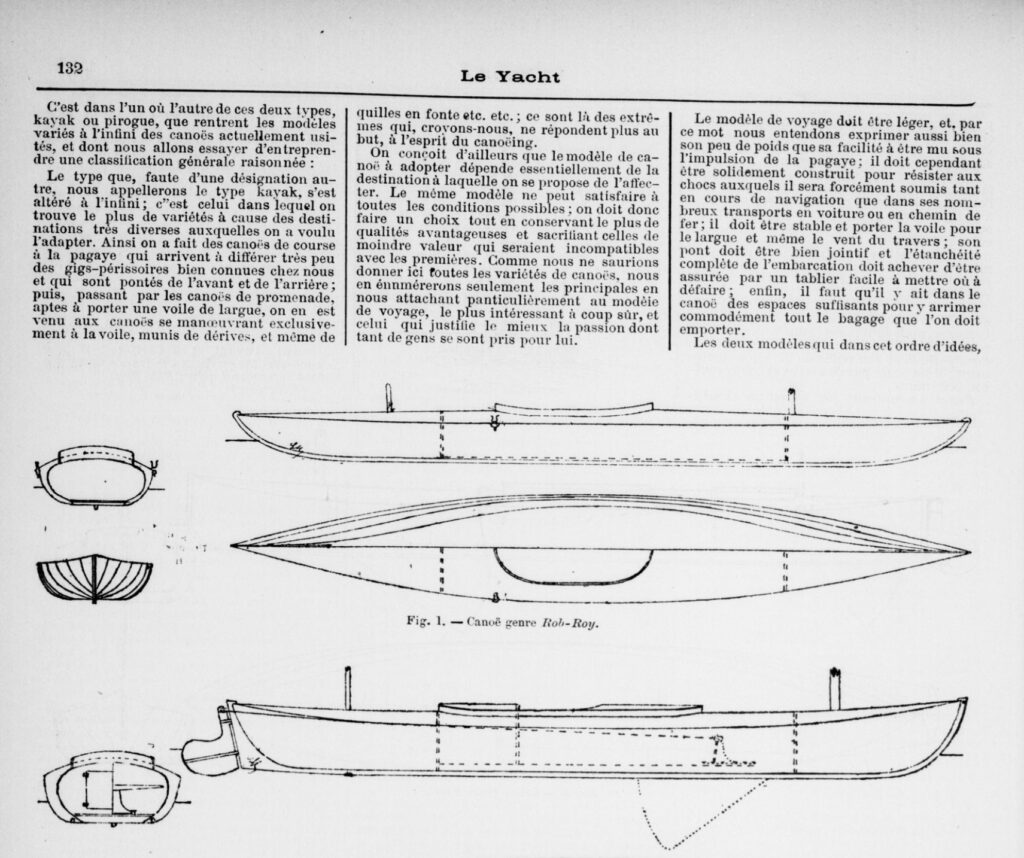
MacGregor’s influence was relayed by the French intellectual elite who read English. His writings inspired the creation of the Union des Yachts Français (founded in 1867, the year of his visit), which later became the Yacht Club de France.
French clubs began to encourage “pleasure cruising” rather than focusing solely on speed competitions. MacGregor’s accounts were translated and adapted, pushing French builders to produce boats “in the style of the Rob Roy”—more stable, safer, and easier to handle.
In summary : pleasure boating (before vs. after MacGregor)
Pleasure boating before MacGregor
– Aristocratic Model
– Numerous professional sailors on board.
– Large units (15m+), heavily ballasted.
– Luxury port to luxury port.
– Speed and social prestige
Pleasure boating after MacGregor
– The “Rob Roy” model
– Solo sailor or couple-based navigation
– Small sailboats (6m to 9m), agile.
– Exploration of creeks and rivers.
– Autonomy and personal adventure.
John McGregor founded the Royal Canoe Club in 1866. Both Nautilus III and Pearl III were RCC boats.
Nautilus III
Nautilus III was sailed by a man with a famous last name : Warrington Baden-Powell.
He was a British admiralty lawyer, master mariner and canoeist. He wrote a book on Sea Scouting and held positions in The Boy Scouts Association, formed by his brother, Robert Baden-Powell.
And Warrington was a friend of John Mc Gregor.
In July 1869, accompanied by a companion known only as “H”, possibly his brother Baden Henry, Warington undertook a canoeing expedition in the Baltic Sea, and published an account of his adventures in 1871.
No need to look any further to find a predecessor to the Vianney couple, founders of the Glénans in France.
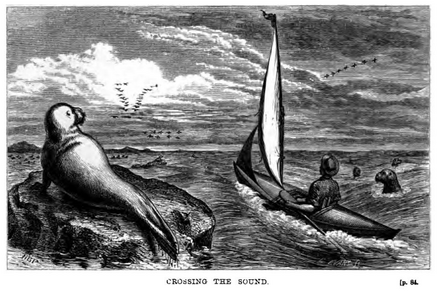
Pearl III
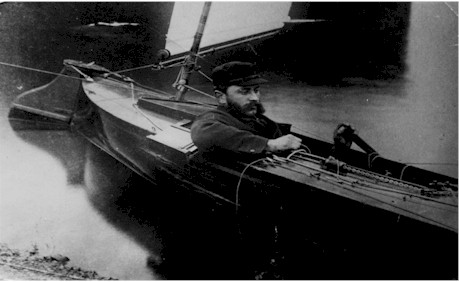
Pearl III, by Tredwen, is the third major canoe yawl design from the members of the RCC.
Daisy
Daisy is one of the very first Humber Yawls. George Holmes lived from 1861 to 1940 on the northern side of the Humber estuary. He was an avid and accomplished sailor in small craft of his own design, in British waters and in mainland Europe, and his prolific writing and drawing have left us an absorbing and charming record of his cruises, his boats, and the people and places he encountered.
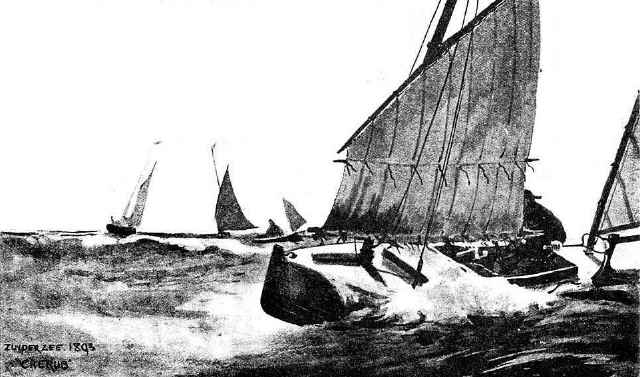
In common with his friend and sailing companion Albert Strange, boats were not his regular occupation but were a diversion from his working life. And along with Strange, his name is forever associated with the development of the Canoe Yawl.
He was part of the Eastern branch of the RCC, and probably decided that the restriction on beam (2ft. 6in.) laid down by the RCC was incompatible with a sea-going or at least eastuary going yacht. He went for more beam and more weight, forming the Humber Yawl Club with no restriction on the dimensions of its crafts.
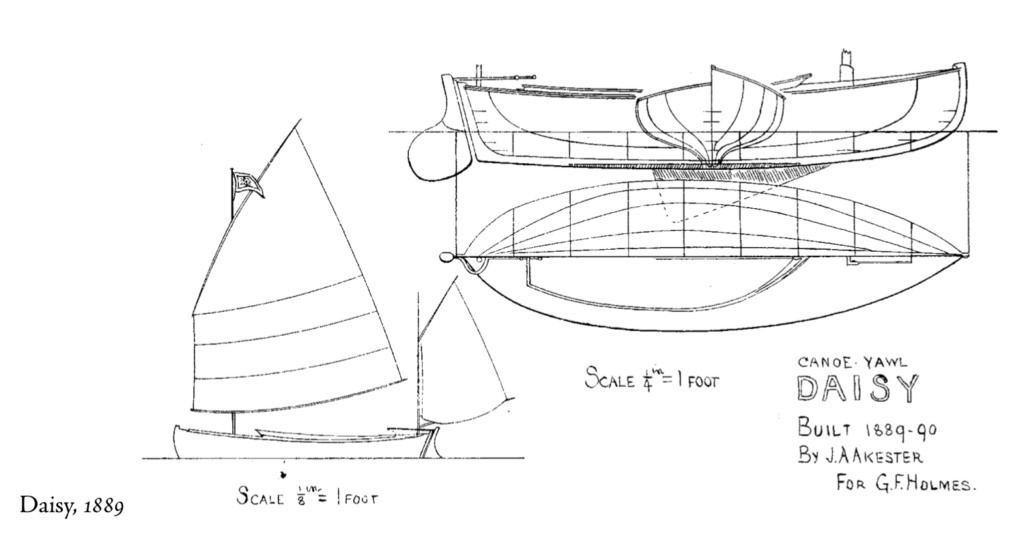
Daisy was 18ft, with only 16in draught and contributed towards the displacement cruisers.
Cherub II
Strange joined the Humber Yawl Club in 1891 and was a founding member of the Scarbourough Sailing Club in 1895. He designed his first boat, Cherub, in 1888, for his use, and later Cherub II. She was a double-ender (i.e. with a stern-hung rudder) rather than having a canoe counter and carried a light displacement. Cherub II wore a fully battened lug mainsail. At the Humber Yawl Club, this was known as a “Club Rig”.
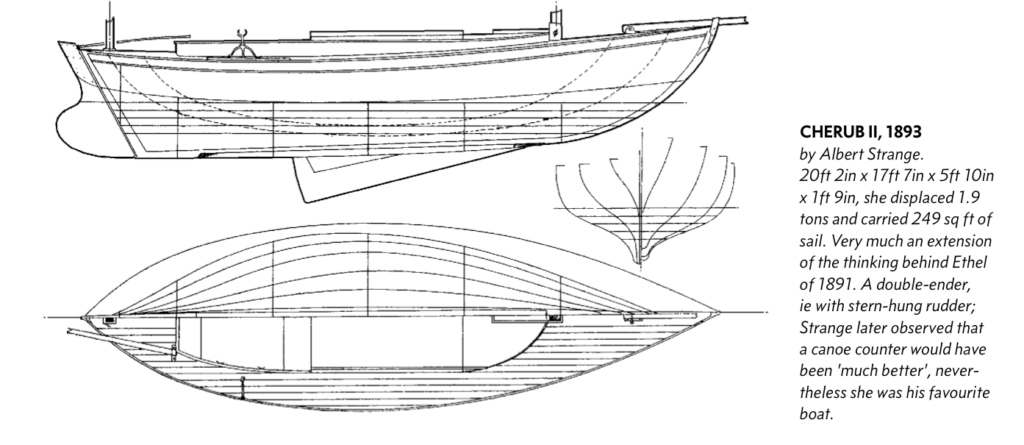
Cherub II was sailed extensively by Strange and her characteristics became an integral part of his design philosophy.
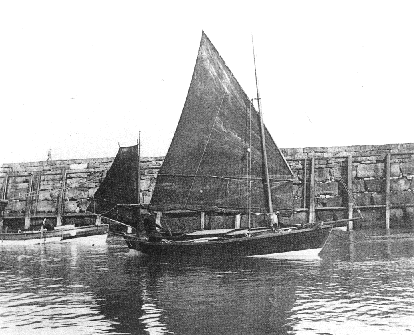
Photograph from The Albert Strange Association
Strange described Cherub II as “my most beloved boat”
Descendants
Mist
Mist was built in 1907 as a larger version of Sheila. Like Sheila, she was intended for the turbulent waters of the Irish Sea. Still, she was rather lightly built with pitch pine (below) and mahogany (above) planking.
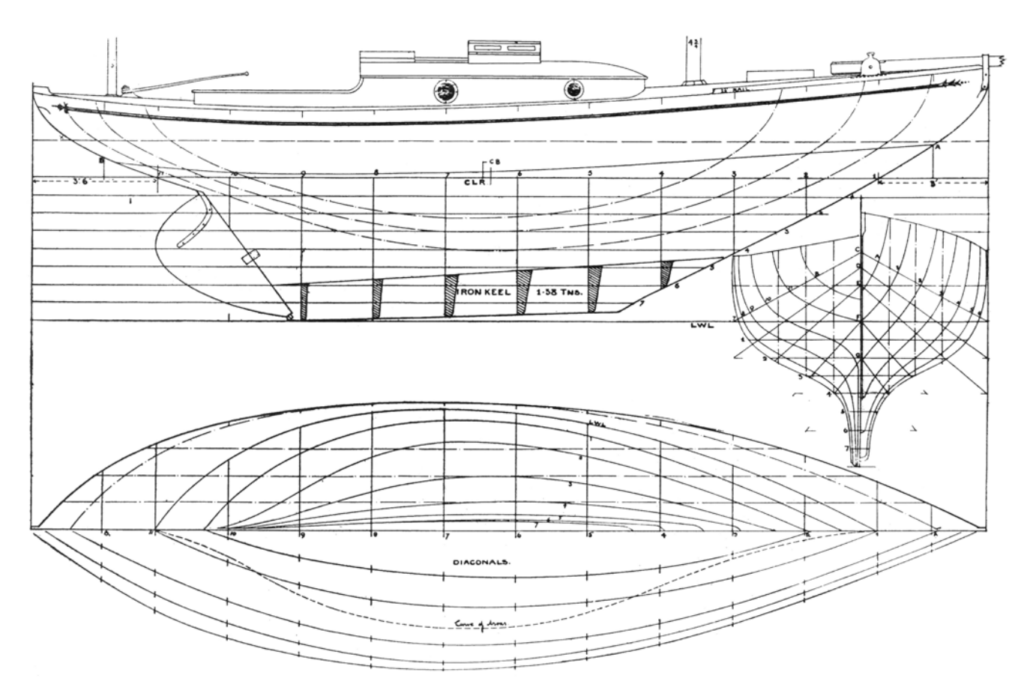
Mist sank on her mooring on the Gareloch in Scotland and was lovingly saved and restored by the ASA and the same team associated with Sheila in 2006.
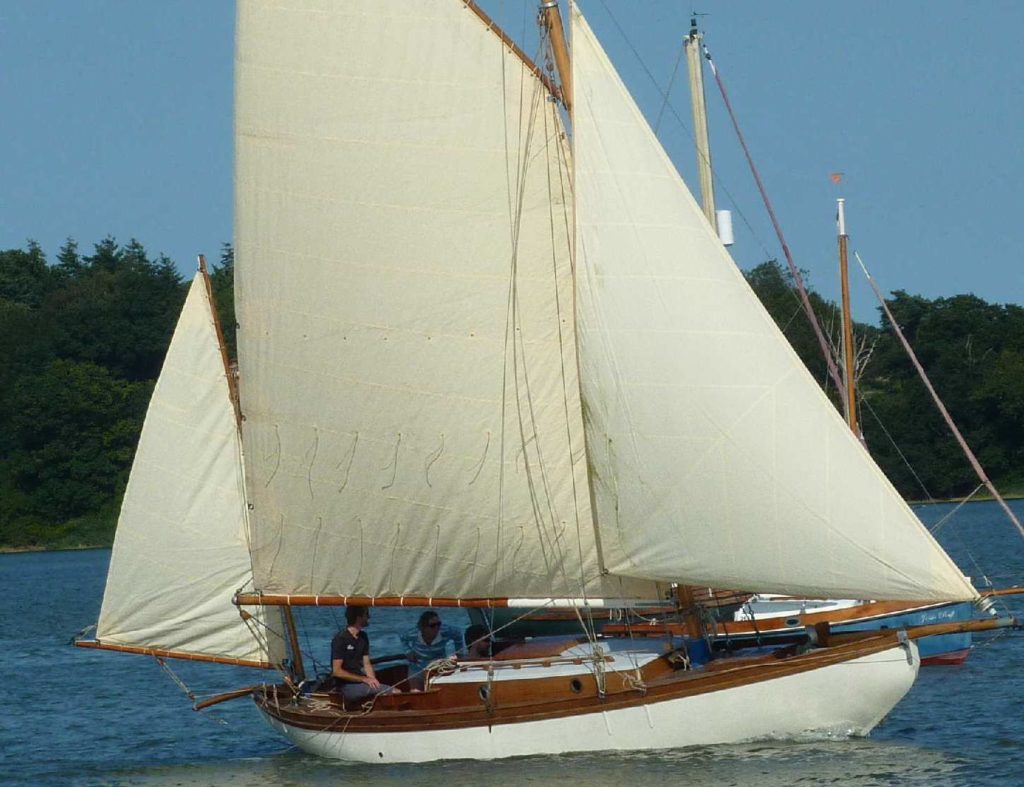
Sheila II
Along with Sheila and Tally-Ho, Sheila II is undoubtedly the most famous Albert Strange design, achieving fame in Adrian Hayter’s “Sheila in the Wind“.
More on Sheila II is on https://www.rebeccahayter.co.nz/post/sheila-ii-the-boat-and-the-book, based on a story first published in Classic Boat magazine, UK, February 2021
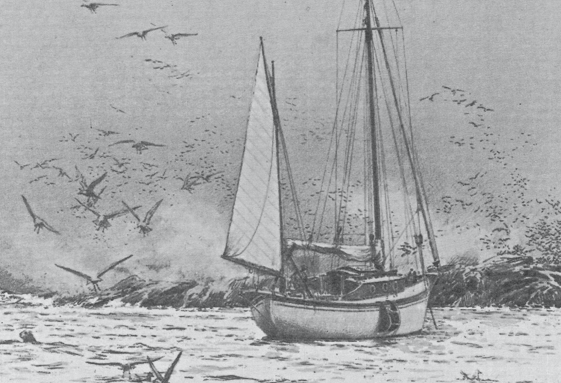
In 1911, Sheila II was built by Dickie of Tarbert, Scotland for Robert Groves. “Her design was commissioned from Albert Strange around 1908 following his original Sheila launched in 1905. Groves has left some very evocative sketches of both boats under sail. Given a free rein by the client, Strange would always favour performance over accommodation, believing it to be an important safety feature; this resulted in some of his most beautifully proportioned designs, of which Sheila II, some would argue, is the finest.”
Sheila II is 31ft 6in on the waterline, 8ft 6in beam and 5ft 10in draft. She displaces 6.2 tons. She originally set a roller furling jib, a gaff mainsail with a yard topsail over and a gaff mizzen sheeted to a bumkin. The hull was built of full-length pitch pine planking on oak frames on the rigid base of a long cast-iron ballast keel.
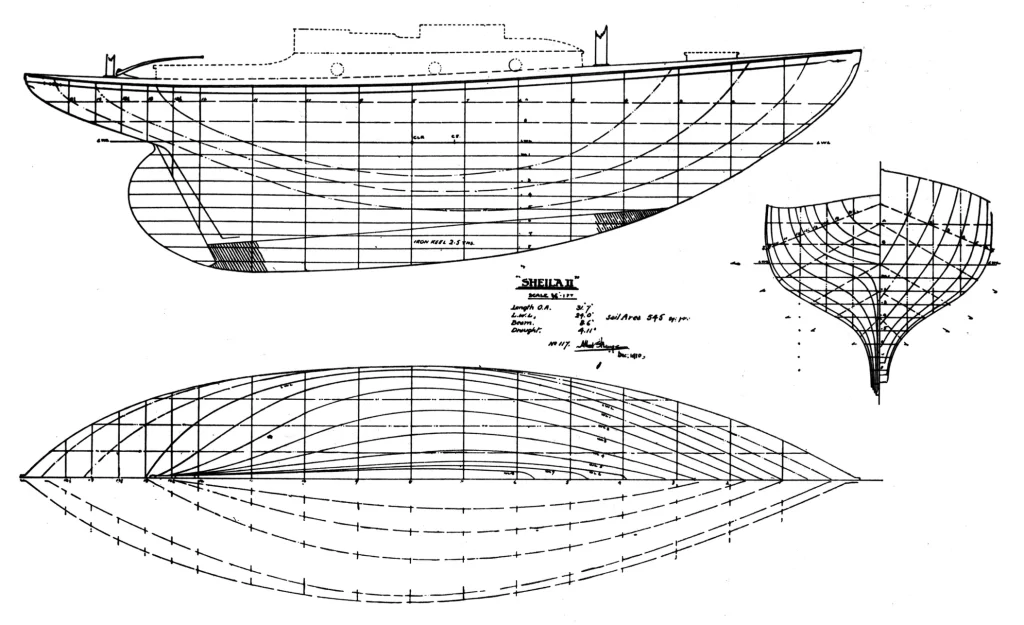
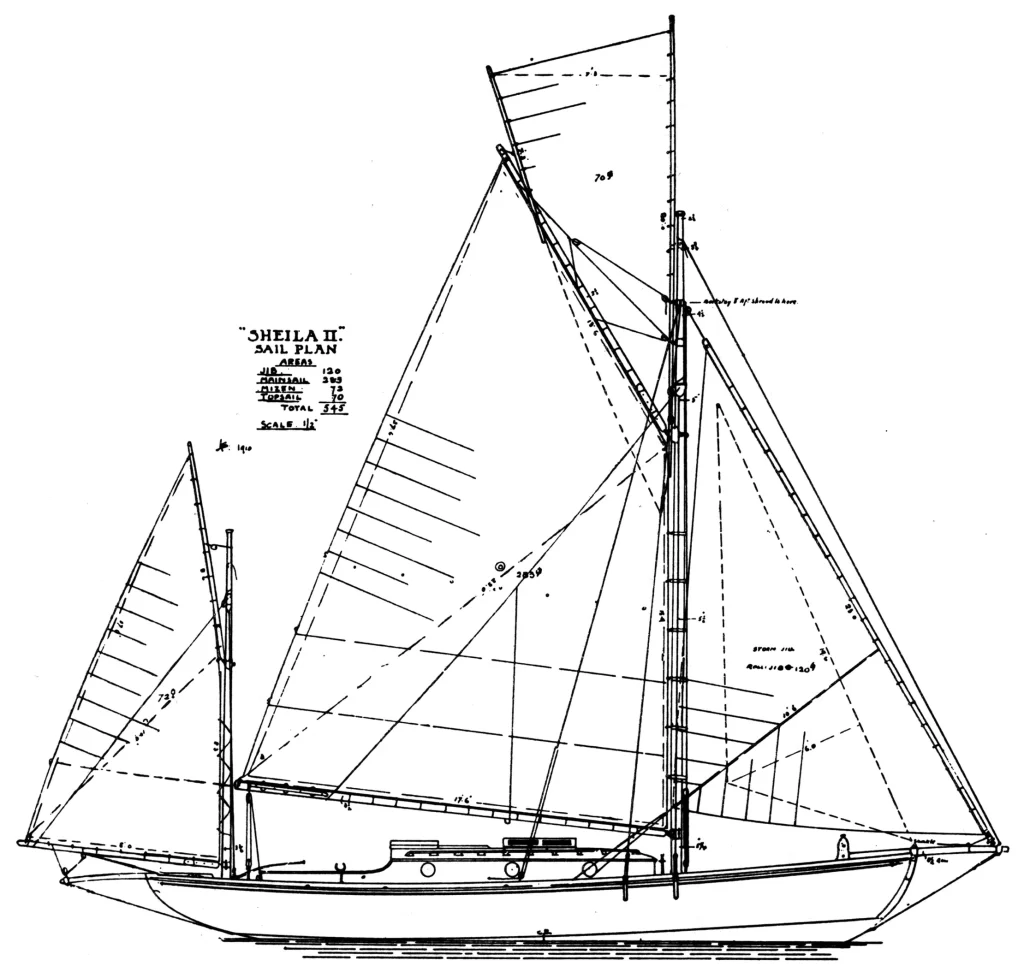
In 1922 Groves sold to Sheila II to Patrick Walsh – who had bought Sheila from him in 1910.
Adrian Hayter, a New Zealander, had virtually no sailing experience when he purchased Sheila II in 1949. In the previous decade, he had fought as a British officer with a Gurkha regiment in the Second World War, earning the Military Cross; witnessed the Partition of India and been actively involved in the Malayan Emergency.
Hayter decided to sail her back to his home in New Zealand and achieved to arrive in Westport, New Zealand in 1956, in a do-or-die surge through breaking seas. He became the first person to sail solo from UK to New Zealand.
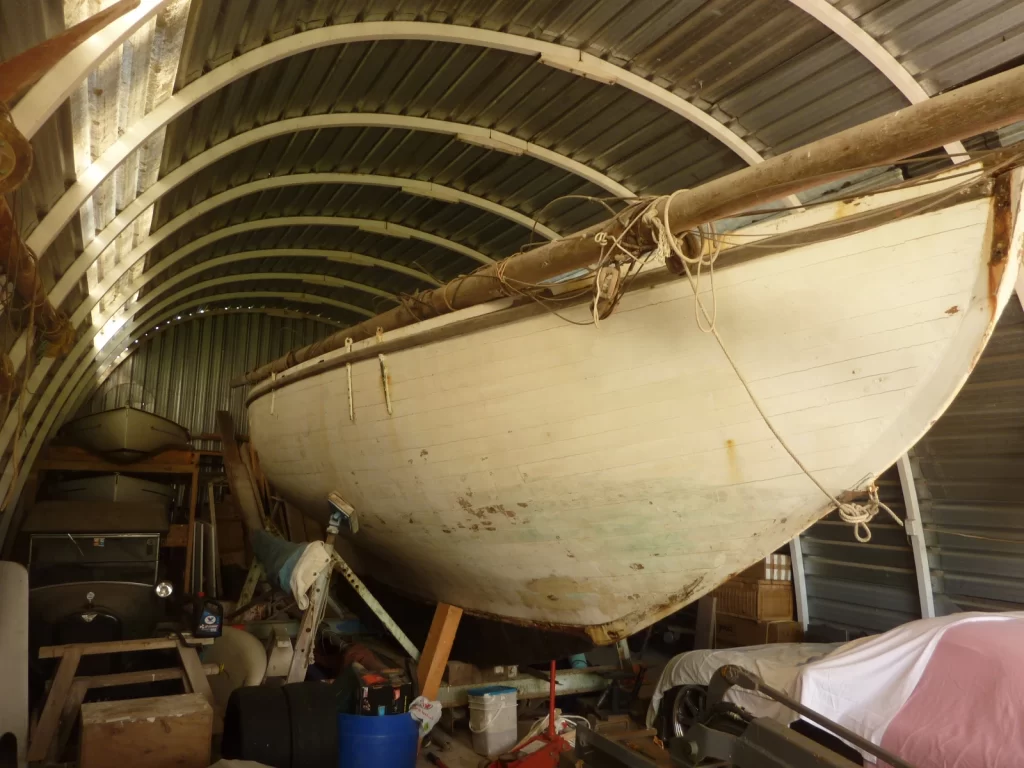
In 1983, Sheila was still in New Zealand when she broke her moorings off Devonport Yacht Club and suffered extensive damage. Two owners later and still in disrepair, she was bought by Russ Rimmington who kept Sheila II from further deterioration but other projects intervened and he is looking for a buyer to undertake her restoration. (If interested in purchasing Sheila II, please contact Russ Rimmington in New Zealand, email [email protected].)
Ortegal
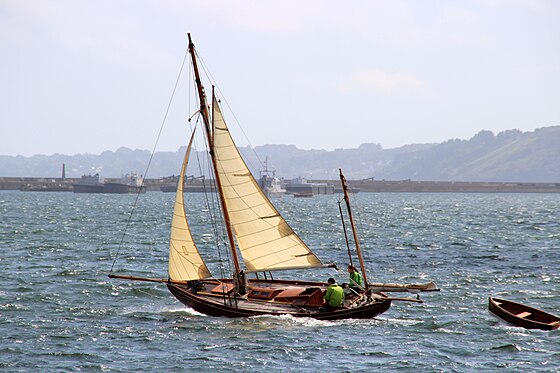
Ortegal is a gaff rigged canoe yawl built in 2003. She is a based on Albert Strange designs.